


Morocco's Must-See Historical & Traditional Destinations
Guide to Morocco's best historical sites: Fes medina, Marrakech medina, Aït Benhaddou, Volubilis, Meknes and Chefchaouen — all UNESCO-listed, all reachable by car.
Morocco is one of the rare countries where history is not behind glass in a museum — it is lived in, traded in, and prayed in every single day. Its four imperial cities contain medinas that have never been abandoned or demolished, their street plans unchanged since the medieval period. The country has nine UNESCO World Heritage Sites and several more on the tentative list. A rental car unlocks the full circuit: you can move from a Roman forum to a Berber kasbah to a medieval university in a single day's drive, on your own schedule, with no tour group setting the pace.
Fes el-Bali — the oldest intact medieval city in the world: Fes el-Bali, the ancient walled medina of Fes, was inscribed as a UNESCO World Heritage Site in 1981 and is widely considered the best-preserved medieval Islamic city on earth. Founded in the 9th century by Moulay Idriss II, it is home to the Karaouiyine Mosque and University — established in 859 AD and recognised by UNESCO and the Guinness World Records as the oldest continuously operating educational institution in the world. Walking into Fes el-Bali through Bab Bou Jeloud, the ornate blue-and-green gate, is to step directly into the 14th century. The tanneries of the Chouara quarter, where leather has been dyed using the same pit-and-pigment method for over a thousand years, are best viewed from the terraces of the surrounding tannery shops. The Bou Inania Madrasa (14th century), with its carved cedar ceilings, zellige tilework, and stucco facades, is one of the finest examples of Marinid architecture anywhere. There is no driving inside the medina: park at the walls, enter on foot, and allow at least a full day.
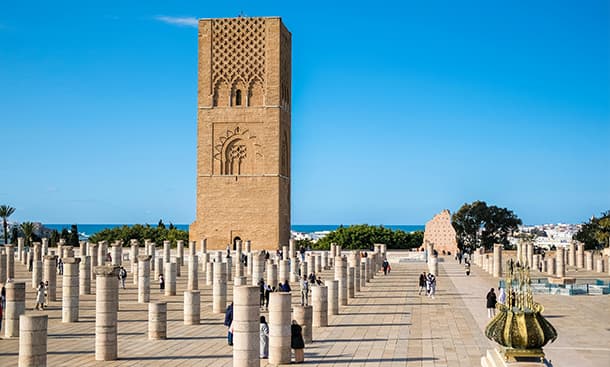
Marrakech Medina and the Djemaa el-Fna: Marrakech's medina was inscribed as a UNESCO World Heritage Site in 1985, and the Djemaa el-Fna square is separately listed as UNESCO Intangible Cultural Heritage — the only urban space in the world to hold that designation. The square changes character completely throughout the day: orange juice vendors and snake charmers in the morning; a vast open-air market by afternoon; and at sunset, a city of food stalls, storytellers, gnawa musicians, and acrobats materialises out of nowhere, lit by gas lanterns and the smell of grilled meats. The Koutoubia Mosque, built in the 12th century by the Almohad dynasty, is the landmark visible from across the city and the architectural reference point for the Giralda in Seville and the Hassan Tower in Rabat. The Saadian Tombs, hidden and sealed for nearly three centuries and rediscovered by aerial photography in 1917, contain the elaborately decorated mausoleum of Sultan Ahmad al-Mansur. The Bahia Palace and the ruins of the El Badi Palace, built by the same sultan who later destroyed it to reuse its materials, are both within walking distance of the Djemaa el-Fna.
Aït Benhaddou — the ksar on the caravan route: Aït Benhaddou, inscribed as a UNESCO World Heritage Site in 1987, is a fortified earthen village (ksar) of interconnected pisé kasbahs perched above the Ounila River, 30 km northwest of Ouarzazate on the ancient trans-Saharan caravan route between the Draa Valley and Marrakech. The site has been used as a filming location for more than thirty major productions, including Gladiator, Game of Thrones (as Yunkai), Lawrence of Arabia, The Mummy, Jewel of the Nile, and Babel. Entry to the ksar is free; crossing the river to reach it is done on foot via stepping stones or a small footbridge. A local guide hired at the entrance (30–50 MAD) provides genuine historical context that the site's sparse signage does not. The drive from Marrakech over the Tizi n'Tichka pass is itself one of Morocco's great road experiences — allow a full day for the round trip or continue south to Ouarzazate and the Draa Valley.
Volubilis — Morocco's Roman city: The archaeological site of Volubilis, located 33 km north of Meknes near the town of Moulay Idriss Zerhoun, was inscribed as a UNESCO World Heritage Site in 1997. Founded in the 3rd century BC as a Berber settlement, it became an important Roman outpost and eventually the westernmost capital of the Roman province of Mauritania Tingitana in the 1st century AD, reaching its peak population of around 20,000 inhabitants. What remains today is exceptional: the Triumphal Arch of Caracalla (erected in 217 AD), the Capitol and Basilica complex, the House of Orpheus with its extraordinary in-situ mosaic floor, the Gordian Palace, and dozens of other structures across a 42-hectare site. The mosaics at Volubilis are among the finest Roman mosaics still visible in their original positions anywhere in the world. The site sits amid rolling wheat and olive fields and is best visited early morning before tour groups arrive from Fes and Meknes. From Meknes it is a 35-minute drive; from Fes approximately one hour.
Meknes and Chefchaouen: Meknes, whose medina was inscribed as UNESCO World Heritage in 1996, is one of Morocco's most undervisited imperial cities — consistently overlooked in favour of Fes and Marrakech, and consistently rewarding to those who stop. Sultan Moulay Ismaïl (1672–1727) wanted to build a Moroccan Versailles, and the scale of his ambition is still visible in the Bab Mansour gate — one of the most imposing and ornately decorated city gates in North Africa — and in the Heri es-Souani royal granaries and stables, which could hold 12,000 horses and their fodder. A day in Meknes easily combines with a visit to Volubilis (35 km) and the holy pilgrimage town of Moulay Idriss Zerhoun (4 km from Volubilis), Morocco's most important religious site after Mecca and Medina for Moroccan Muslims. Chefchaouen, while not a UNESCO site, deserves a place on any historical road trip. Founded in 1471 as a mountain fortress by Moulay Ali ibn Rashid to defend against Portuguese incursions, it has been painted in successive shades of blue since the 1930s, when Jewish refugees fleeing Nazi Europe settled here and whitewashed the walls — a tradition continued by residents ever since. The medina is compact and walkable in two to three hours; the surrounding Rif mountains offer hikes to the Spanish Mosque viewpoint (45 minutes on foot) and the Ras el-Maa waterfall at the edge of town.